
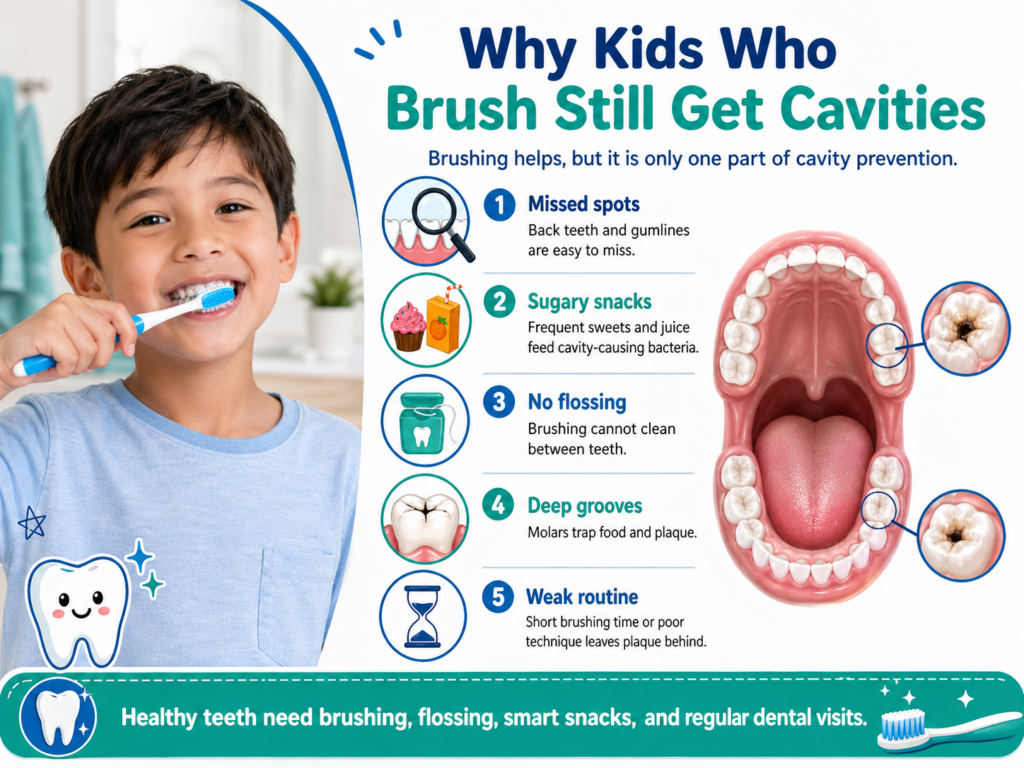
Few things are more frustrating for a parent than hearing their child has a cavity when they’ve been brushing every night without fail. It feels like the rules weren’t fair. The truth is that brushing, while essential, is only one piece of a more complex picture — and understanding why kids who brush still get cavities is the first step toward actually preventing them.
Cavities don’t develop simply because a tooth wasn’t brushed. They develop through a specific biological process involving bacteria, sugar, acid, and time — and brushing addresses only part of that equation. Diet, brushing technique, tooth anatomy, fluoride exposure, saliva, and genetics all play meaningful roles. A child can brush twice a day and still be at high cavity risk if several of these other factors are working against them. Here’s what’s actually going on — and what makes a real difference.
Cavities Are Caused by Bacteria and Acid — Not Just Missed Brushing Sessions
Understanding why cavities form makes it much clearer why brushing alone doesn’t always prevent them. The process works like this: the mouth is home to naturally occurring bacteria — most significantly Streptococcus mutans — that feed on sugars and fermentable carbohydrates. When these bacteria consume sugar, they produce acid as a byproduct. That acid sits on the tooth surface and gradually dissolves the mineral content of the enamel — a process called demineralization. When demineralization outpaces the mouth’s natural remineralization process over time, a cavity forms.
Brushing disrupts this process by physically removing bacteria and food debris from tooth surfaces. But it only removes what the bristles can reach. The spaces between teeth, the deep grooves on the chewing surfaces of molars, and areas at the gumline where brushing technique falters are all locations where bacteria can persist and produce acid undisturbed — regardless of how consistently a child brushes the surfaces that are easy to reach.
This is why a child who brushes reliably but never flosses, or who brushes but consumes frequent sugary snacks throughout the day, or who brushes but has deep molar grooves and no sealants, can still develop cavities at a regular dental visit. The brushing is doing its job on the surfaces it reaches — but the cavity-forming process is happening somewhere else.
Diet Frequency Matters More Than Most Parents Realize
Most parents know that sugar causes cavities — but the part that often gets missed is that how often a child consumes sugar matters more than how much they consume in a single sitting. Every time the mouth is exposed to sugar or fermentable carbohydrates, cavity-causing bacteria produce acid, and that acid attacks tooth enamel for approximately 20 to 30 minutes after the exposure ends.
A child who drinks a large glass of juice with breakfast and then has nothing else sugary all day exposes their teeth to one acid attack per day. A child who sips juice, a sports drink, or a flavored water over the course of several hours exposes their teeth to a near-continuous acid attack that never fully resolves between sips. From a cavity risk standpoint, the second scenario is dramatically more damaging — even if the total sugar consumed was similar.
Common dietary patterns that create high cavity risk in children who otherwise brush regularly include:
- Frequent snacking throughout the day — crackers, granola bars, dried fruit, and other snacks that seem relatively harmless contain fermentable carbohydrates that trigger acid production with each exposure
- Sipping sugary or acidic drinks slowly — juice, sports drinks, flavored milk, and even 100% fruit juice maintain a near-constant acid environment when sipped over time rather than consumed at once
- Sticky or gummy foods — gummy vitamins, fruit snacks, raisins, and similar foods adhere to tooth surfaces and grooves, extending the duration of sugar exposure well beyond the time spent eating them
- Bedtime bottles or sippy cups with anything other than water — milk or juice consumed at bedtime and left in contact with teeth through the night is one of the most cavity-promoting patterns in young children, contributing directly to early childhood tooth decay
- Acidic foods and beverages — citrus fruits, tomato-based foods, and carbonated drinks (including sparkling water) are acidic independently of their sugar content and soften enamel even when sugar isn’t the primary concern
Shifting from continuous sipping to defined meal and snack times — with water as the default drink between them — is one of the highest-impact dietary changes families can make for cavity prevention, independent of brushing habits.
Brushing Technique and Timing Have More Impact Than Parents Expect
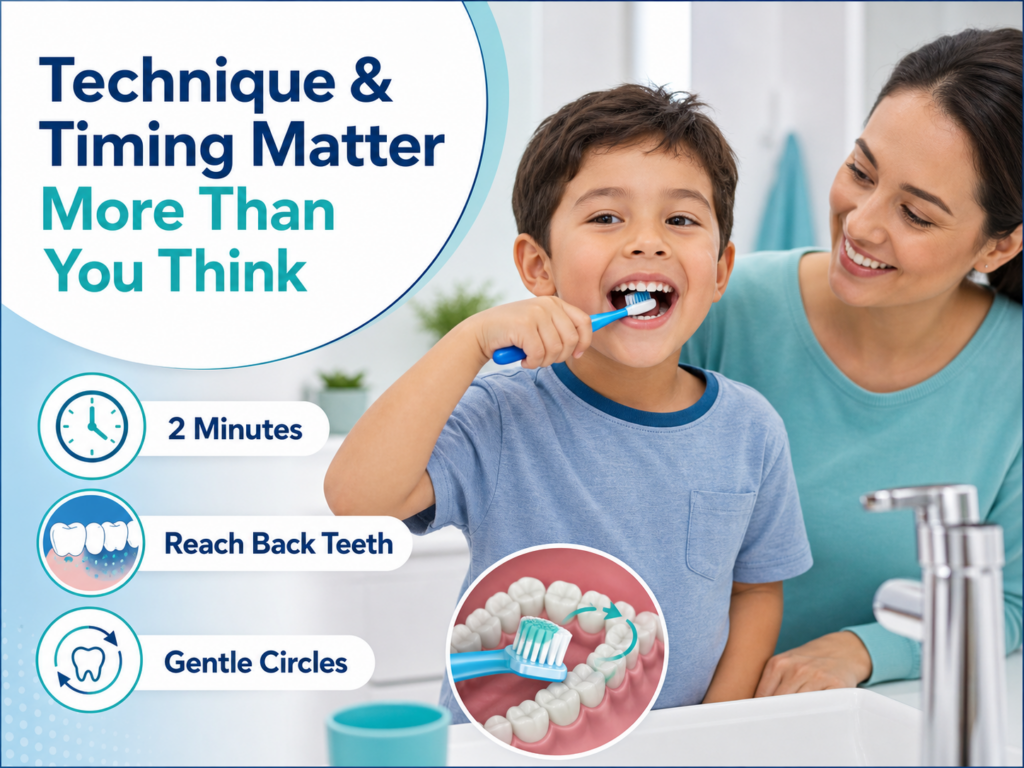
When a child brushes matters almost as much as whether they brush. Brushing before bed is the most important session of the day — not because nighttime is magical, but because saliva flow decreases significantly during sleep, eliminating the mouth’s natural defense against acid and bacteria. Anything left on the teeth at bedtime sits there for 8 or more hours without the diluting and buffering effect of saliva. A thorough brush before bed — and no eating or drinking anything other than water afterward — is the highest-leverage brushing habit a child can have.
Brushing technique also matters more than most parents assume, particularly for younger children. Common technique problems that limit brushing effectiveness include:
- Not brushing long enough — the recommended two minutes covers all surfaces adequately; most children brushing independently brush for 30 to 45 seconds, which leaves significant plaque behind
- Missing the gumline — the area where the tooth meets the gum is where plaque accumulates and where early decay and gum inflammation begin; effective brushing angles the bristles toward the gumline, not just across the middle of the tooth
- Missing the back molars — children tend to brush the teeth they can see easily in the mirror and rush past the back molars, which are both the hardest to reach and the most cavity-prone
- Brushing too hard — aggressive brushing with a hard-bristled brush can wear enamel and damage gums without improving plaque removal; a soft-bristled brush with gentle circular or back-and-forth motion is more effective
- Independent brushing too early — the American Academy of Pediatric Dentistry recommends that parents assist with or supervise brushing until children are around age 7 to 8, when fine motor skills are developed enough for thorough independent technique
At Czarkowski Pediatric Dentistry, we demonstrate proper brushing technique at every checkup — for both children and parents — because technique is one of the most correctable cavity risk factors and one of the most overlooked.
Fluoride Exposure, Tooth Anatomy, and Saliva All Affect Cavity Risk Independently of Brushing
Even a child with good brushing habits, a low-sugar diet, and excellent technique can face elevated cavity risk from biological and anatomical factors that brushing simply doesn’t address.
Fluoride Exposure
Fluoride strengthens tooth enamel by incorporating into its mineral structure, making it more resistant to acid attacks. Children who brush with fluoride toothpaste and drink fluoridated tap water have meaningfully stronger enamel than those who don’t. A child who brushes with a non-fluoride “natural” toothpaste, or who drinks exclusively bottled or filtered water that lacks fluoride, may be brushing effectively but missing one of the most evidence-backed tools for cavity prevention. The ADA recommends brushing with a fluoride toothpaste starting when the first tooth erupts — a smear the size of a grain of rice for children under 3, and a pea-sized amount from age 3 onward.
Tooth Anatomy
Some children are simply born with deeper pits and fissures in their molars than others. These anatomically deep grooves harbor bacteria that a toothbrush cannot physically reach, regardless of technique or duration. Dental sealants are specifically designed to address this — by sealing those grooves before decay can begin. A child with deep molar grooves who hasn’t had sealants placed will continue to be at elevated risk for pit-and-fissure cavities no matter how well they brush.
Saliva Flow and Composition
Saliva is one of the mouth’s most important natural defenses against cavities. It neutralizes acid, dilutes sugars, provides minerals for remineralization, and contains antibacterial proteins. Children with naturally lower saliva flow — or those who breathe through their mouths at night, which dries the oral environment — have less of this protection available. Certain medications, including antihistamines and some ADHD medications, reduce saliva flow as a side effect, which can increase cavity risk even in children with otherwise good oral hygiene.
Genetics and Enamel Quality
Enamel strength and the composition of the oral bacteria population both have genetic components. Some children inherit stronger enamel that resists acid more effectively; others have thinner or less mineralized enamel that is more vulnerable. Similarly, the specific strains of cavity-causing bacteria present in a child’s mouth — which can be influenced by early exposure from parents or caregivers — affect baseline cavity risk. This is one reason why cavity history can run in families even when oral hygiene habits are similar.
What Actually Makes a Difference for Cavity-Prone Kids
If your child brushes regularly and still gets cavities, the answer isn’t brushing harder or more often — it’s identifying which of the other risk factors is driving the problem and addressing it directly. Here’s what genuinely moves the needle:
- Add flossing — once teeth are touching, brushing cannot clean between them. Interproximal (between-tooth) cavities are among the most common in school-age children and are almost entirely a flossing problem, not a brushing problem.
- Reduce snack frequency — consolidate eating to defined meals and snack times with water between them to limit the number of daily acid exposures.
- Switch to water as the default drink — replacing juice, sports drinks, and flavored beverages with water between meals eliminates a major continuous acid source.
- Use fluoride toothpaste correctly — the right amount, twice a day, with the toothpaste spit out rather than rinsed away (a light rinse at most) to maintain fluoride contact with enamel after brushing.
- Ask about sealants — if your child’s molars have deep grooves, sealants are one of the most effective interventions available for pit-and-fissure cavities.
- Ask about fluoride varnish — applied at dental checkups, professional fluoride varnish provides a concentrated fluoride treatment that significantly strengthens enamel between visits.
- Keep up with regular checkups — catching early-stage decay before it becomes a full cavity allows for remineralization treatment rather than drilling; what is a white spot lesion today can become a cavity that needs a filling if it goes undetected for another year.
Frequently Asked Questions About Cavities in Kids Who Brush
Is it normal for a child to get cavities even with good oral hygiene?
Yes — and it doesn’t mean anyone has failed. Brushing is important, but it’s one factor among several that determine cavity risk. Tooth anatomy, diet patterns, fluoride exposure, saliva, and genetics all contribute independently. A child who gets cavities despite brushing consistently is a child whose other risk factors need to be identified and addressed — not a child who needs to brush harder. This is exactly the kind of conversation Dr. Kara has with families at every checkup.
Could my child’s cavities be between the teeth rather than on the chewing surface?
Very possibly. Interproximal cavities — those that form between teeth where they contact each other — are extremely common in children and cannot be prevented by brushing alone. They develop when plaque sits between teeth that are touching, and they are only visible on dental X-rays in their early stages. If your child brushes well but keeps getting cavities, ask Dr. Kara whether the cavities are interproximal — if they are, adding consistent daily flossing is the targeted solution.
What toothpaste should my child be using?
A fluoride toothpaste appropriate for your child’s age is the standard recommendation from both the ADA and the AAPD. For children under 3, a smear the size of a grain of rice; for children 3 and older, a pea-sized amount. Avoid non-fluoride “natural” or “training” toothpastes for children at elevated cavity risk — the fluoride is the active cavity-preventing ingredient, and removing it removes the primary protective benefit. If you have questions about specific products, Dr. Kara is happy to make a recommendation based on your child’s individual needs.
How does diet affect cavities if my child only has sweets occasionally?
Frequency of sugar exposure matters more than the total amount consumed. A single candy bar eaten in five minutes causes one acid attack. A bag of crackers snacked on over two hours while watching a movie causes a near-continuous acid attack for that entire period — despite containing less sugar than the candy bar. Fermentable carbohydrates in everyday foods like crackers, bread, chips, and cereal are often overlooked as cavity contributors because they don’t taste sweet, but they feed cavity-causing bacteria just as effectively as obvious sweets.
Should I be worried if my child gets a cavity in a baby tooth — it’s going to fall out anyway, right?
Baby teeth matter more than many parents realize. They hold space for the permanent teeth developing beneath them, support proper chewing and nutrition, aid in speech development, and affect your child’s comfort and confidence. An untreated cavity in a baby tooth can become painful, spread to neighboring teeth, and in some cases affect the developing permanent tooth below it. Baby teeth in the back of the mouth typically aren’t lost until age 10 to 12 — that’s a long time for an untreated cavity to cause problems. Dr. Kara always recommends treating decay in baby teeth promptly, regardless of when those teeth are expected to fall out.
Brushing Is the Foundation — But It Doesn’t Work Alone
Consistent brushing is non-negotiable for your child’s oral health — but it works best as part of a complete approach that also addresses diet, flossing, fluoride, and professional care. If your child keeps getting cavities despite brushing faithfully, the answer is a conversation with Dr. Kara about the specific factors driving their risk — not more brushing.
At Czarkowski Pediatric Dentistry, we take the time at every visit to look at the full picture of your child’s oral health and help families understand exactly what’s contributing to any decay we find. Whether it’s a sealant recommendation, a fluoride varnish application, or a conversation about after-school snack habits, we’re here to help you build a strategy that actually works for your child. Schedule your child’s next checkup and let’s take a closer look together — healthy smiles start here.