
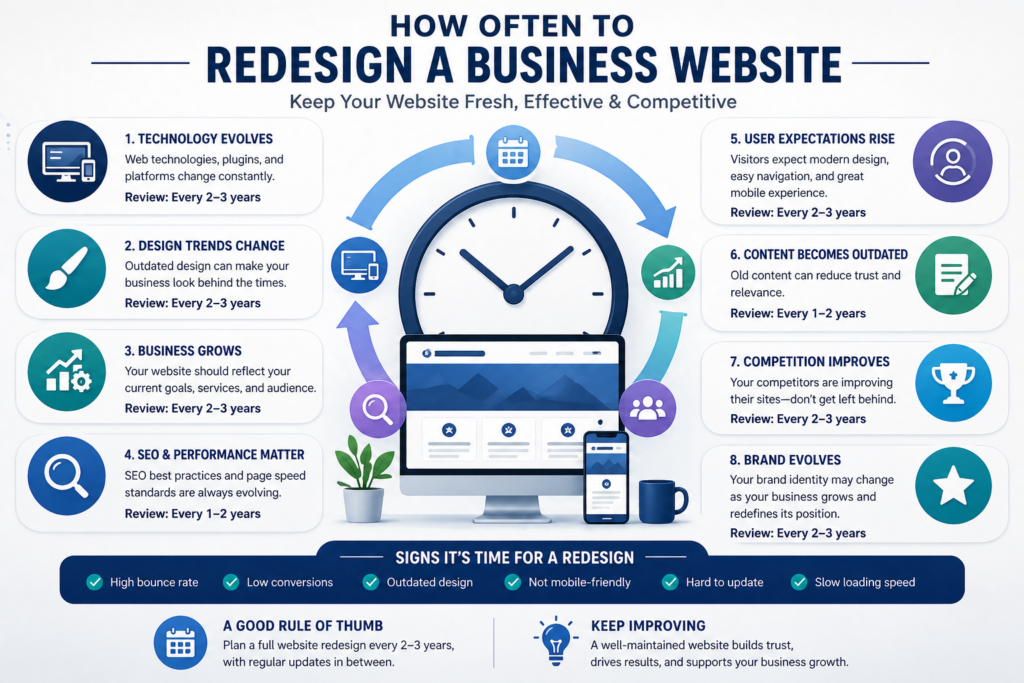
It’s a question most business owners ask eventually — usually when they’re staring at a site that was built several years ago and wondering whether it’s still doing its job. The answer isn’t as simple as picking a number, but it’s also not as complicated as many make it sound. Understanding how often to redesign a business website comes down to a combination of time, performance data, and the specific changes your business has gone through since the last build. At Indy Blitz, we’ve been designing and rebuilding websites for Indianapolis businesses since 2009, and we’ve helped clients navigate this question hundreds of times. Here’s how to think about it honestly.
The 2–3 Year Rule Is a Starting Point, Not a Hard Deadline
The most commonly cited guideline in the web design industry is that businesses should consider a full website redesign every two to three years. It’s repeated often enough that it gets treated as a rule — but it’s really just a pattern that reflects how quickly web technology, design standards, and user expectations tend to evolve.
A site built three years ago was designed before certain mobile standards became universal, before Core Web Vitals became Google ranking factors, and before the current visual and UX conventions visitors now expect. In that sense, the 2–3 year window has some grounding in reality.
But here’s what the rule misses: some well-built websites are still performing exceptionally after four or five years, while others need attention after eighteen months. The age of the site matters far less than how the site is performing. A website that’s generating strong traffic, converting visitors, loading quickly on mobile, and accurately representing your current business doesn’t need a redesign just because the calendar says so. And a site that’s losing traffic, confusing visitors, and misrepresenting your brand needs attention now — regardless of how recently it was built.
The smarter approach is to measure performance against clear signals rather than follow an arbitrary clock.

The Clear Signs It’s Time to Redesign — Regardless of How Old Your Site Is

These are the indicators that tell you a redesign is warranted — not eventually, but soon:
Your Site Doesn’t Work Well on Mobile
Over 60% of all web traffic now comes from mobile devices, and Google uses mobile-first indexing — meaning your mobile performance directly affects how you rank in search results. If your website displays poorly on smartphones, forces users to pinch and zoom to read text, or has buttons too small to tap comfortably, you’re losing a majority of your potential visitors the moment they land. This is one of the most common problems we see in older Indianapolis business sites, and it’s a redesign trigger regardless of everything else.
Your Conversion Rate or Traffic Has Dropped Noticeably
Your website’s job is to generate leads, calls, appointments, or sales. If the number of people taking action on your site has declined significantly — and the decline isn’t explained by seasonal patterns or reduced marketing spend — the site itself is likely the problem. High bounce rates (visitors leaving without clicking anything), short average session durations, and declining contact form submissions are all signals worth taking seriously. When the numbers are consistently moving in the wrong direction for more than two or three months, that’s a performance-based redesign trigger.
Your Business Has Changed But Your Website Hasn’t
This one is more common than most business owners realize. You’ve added services, changed your pricing, updated your brand identity, shifted your target audience, or rebranded entirely — but the website still reflects where the business was two or three years ago. Visitors arriving at a site that doesn’t match your current reality get a mixed message, and mixed messages kill conversions. If your website and your actual business are telling two different stories, it’s time to align them.
Your Competitors’ Sites Look More Professional Than Yours
Search “your service + Indianapolis” right now and look at the first few results. If the sites you see look more modern, more credible, and more trustworthy than yours, that perception gap is costing you business. Visitors don’t know your reputation yet — they’re judging your credibility on what they see in the first few seconds. A competitor with a better-looking, faster-loading site has a real advantage at that moment, regardless of who actually does better work.
Your Site Is Slow, Broken, or Painful to Update
Page speed is both a user experience issue and a direct Google ranking factor. A site that takes more than three seconds to load on mobile loses a significant portion of visitors before they’ve seen a single word of your content. Beyond speed, sites built on older platforms or with outdated themes accumulate technical debt — plugins that conflict, security vulnerabilities, and CMS limitations that make even basic content updates feel like a project. When maintaining the current site requires more effort than it’s worth, that’s a signal the foundation needs to be replaced, not patched.

What’s the Difference Between a Redesign, a Refresh, and Ongoing Updates?
These three things are often confused, and the confusion leads to businesses either overspending on full redesigns when something lighter would do the job, or under-investing with minor tweaks when the site actually needs a structural overhaul.
- Ongoing updates — These are the regular maintenance tasks that should happen continuously: adding blog content, updating service descriptions, refreshing photos, adjusting CTAs, and keeping plugins and security patches current. These don’t change the structure or design of the site. They keep the existing site healthy and signal to search engines that your business is active.
- A refresh — A refresh updates the surface without changing the foundation. Updating your color palette, modernizing fonts, swapping outdated photos for newer ones, or reorganizing a navigation menu are all refreshes. A refresh can meaningfully improve the look and feel of a site without requiring a full rebuild. If the core structure of your site is sound but the visual presentation feels dated, a refresh is often the right call.
- A full redesign — A redesign rebuilds the site from its foundation: new structure, new user experience architecture, new design, new code. This is warranted when the site has multiple simultaneous problems — poor mobile performance, slow load times, outdated branding, and declining conversions — that surface-level fixes can’t adequately address. A redesign is a larger investment but delivers a reset that a refresh cannot.
Most businesses don’t need a full redesign as often as they think. But most businesses also underinvest in ongoing updates and refreshes, which is what allows sites to deteriorate to the point where a full rebuild becomes necessary sooner than it should.
Some Business Types Need to Redesign More Frequently Than Others
The 2–3 year general guideline doesn’t apply equally to every type of business. Industry context matters significantly:
| Business Type | Typical Redesign Cycle | Key Driver |
|---|---|---|
| E-commerce / retail | 18–24 months | Rapidly evolving UX and checkout expectations |
| Service businesses (competitive markets) | 2–3 years | Competitive differentiation and lead generation |
| Professional services (law, finance, consulting) | 3–4 years | Credibility and trust signals |
| Construction, trades, home services | 3–5 years with regular refreshes | Portfolio updates, local SEO, mobile performance |
| Restaurants and hospitality | 2–3 years | Menu changes, visual freshness, reservation integration |
These are starting points, not rules. A highly competitive Indianapolis service business operating in a crowded local market may need more frequent attention than a niche professional services firm with a stable, referral-driven client base. The right timeline is the one driven by your data and your market — not a generic industry average.
What Can You Do to Extend the Life of Your Current Website?
If a full redesign isn’t on the immediate horizon but you want your current site to keep performing, these ongoing practices make the biggest difference:
- Keep content current — Update service descriptions, team bios, and any pricing or availability information regularly. Stale content erodes credibility and signals to search engines that the site isn’t being maintained.
- Monitor Core Web Vitals — Google’s Core Web Vitals (page loading speed, interactivity, and visual stability) are ranking factors. Review your site’s performance in Google Search Console at least quarterly and address issues as they arise.
- Add fresh social proof — Swap in recent testimonials and reviews. A page of reviews from three years ago is less convincing than current ones.
- Check mobile performance regularly — Test your site on different devices and screen sizes every few months. Mobile standards evolve, and a site that was fully responsive two years ago may have developed display issues as browsers and devices have changed.
- Keep your CMS and plugins updated — Outdated WordPress themes, plugins, and PHP versions are the most common source of security vulnerabilities and performance degradation on small business sites.
A well-maintained site can realistically remain competitive for four to five years before a full redesign becomes necessary. A neglected one can require rebuilding after two. The investment in ongoing maintenance isn’t glamorous, but it’s the difference between a website that keeps delivering ROI and one that quietly works against you.
If you’re not sure where your current site stands, Indy Blitz offers website evaluations for Indianapolis-area businesses. We’ll take an honest look at what’s working, what isn’t, and what your best next step is — whether that’s a targeted refresh, a full redesign, or simply a maintenance plan to protect what’s already performing well. Call us at (317) 653-6567 or reach out through our contact page.
Frequently Asked Questions About Website Redesign Timing
How do I know if my website needs a full redesign or just a refresh?
If your site has one or two surface-level issues — outdated photos, a color scheme that no longer matches your brand, a slightly dated font — a refresh is likely sufficient. If you’re dealing with multiple simultaneous problems — poor mobile performance, slow load times, declining traffic, low conversions, and branding that doesn’t match your current business — those compound issues typically indicate that a full redesign will deliver better results than trying to fix each problem individually.
Will a website redesign hurt my SEO rankings?
A poorly managed redesign can temporarily impact SEO if URLs change without proper redirects, if strong content is removed, or if the new site has technical issues the old one didn’t. A well-planned redesign, on the other hand, typically improves SEO over time by addressing technical performance issues, improving mobile responsiveness, and providing a better overall user experience. At Indy Blitz, we build SEO protection into every redesign project — mapping existing pages, implementing redirects, and carrying over metadata that’s working.
How long does a business website redesign typically take?
For most small business websites, a full redesign takes four to eight weeks from kickoff to launch. The timeline depends on the number of pages, the complexity of any custom functionality, how quickly the client provides content and feedback, and the number of revision rounds. Straightforward sites can move faster; more complex projects with custom integrations or e-commerce functionality take longer.
Should I redesign my website if it still looks good but isn’t generating leads?
Absolutely. Design and performance are separate issues, and a site can look visually current while still failing on the conversion side. If your site isn’t generating the leads, calls, or sales your business needs, the problem could be structural — weak calls to action, confusing navigation, poor messaging, or technical performance issues that drive visitors away before they ever engage with the content. A redesign in this scenario focuses on conversion architecture rather than visual refresh.
Is it worth redesigning a website if I plan to rebrand in the next year?
If a full rebrand is genuinely imminent, it usually makes more sense to hold the redesign until the brand identity is finalized so the new site reflects the new brand from launch. In the meantime, targeted fixes — improving page speed, updating CTAs, and addressing critical mobile issues — can keep the current site performing adequately while the rebrand is finalized. Building a new site and then rebuilding it again a year later is a costly approach that most businesses are better off avoiding.